
A 009 layout by Hull Miniature Railway Society
Scale 009 (4mm/1ft)
Gauge 9mm
Size 12’ x 12’
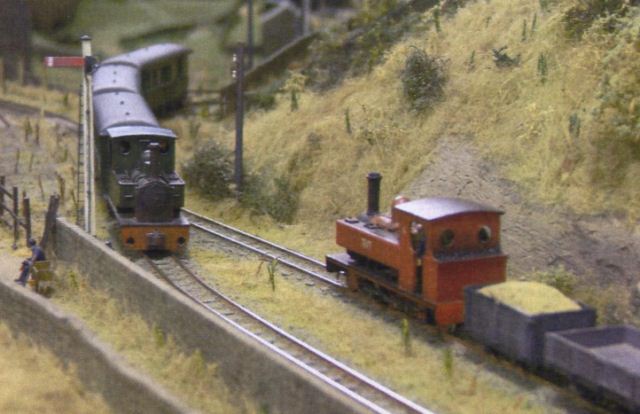
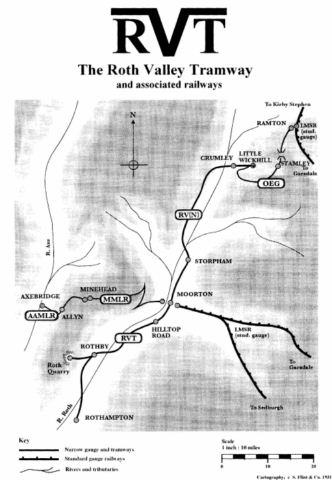
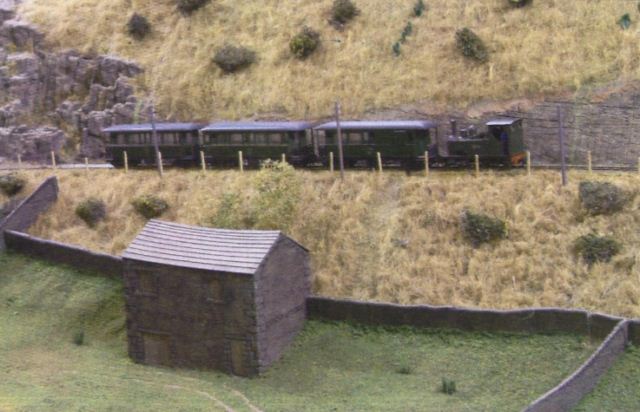
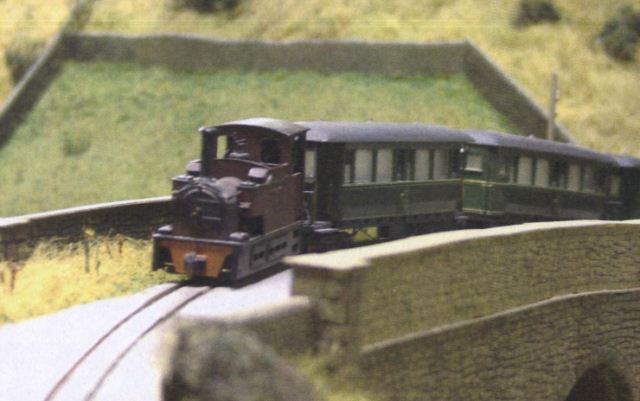
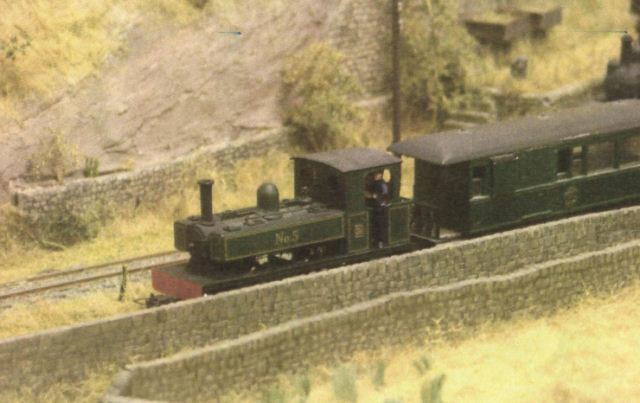
The Roth Valley Tramway (RVT) is a fictitious 2'6" gauge railway serving several communities high in the Pennines around the Lancashire/Yorkshire/Cumberland border area.
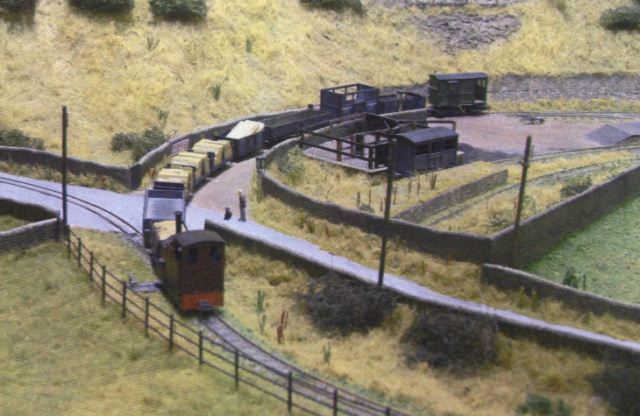
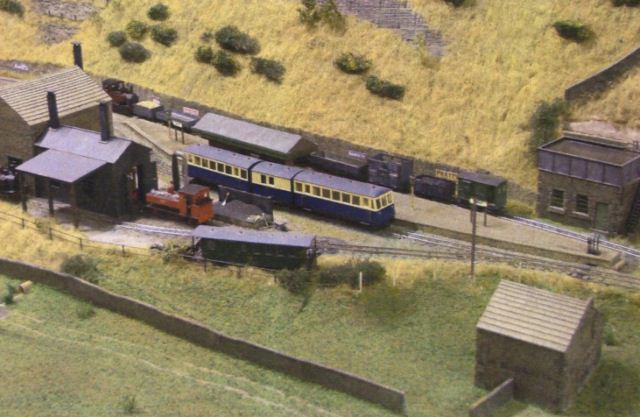
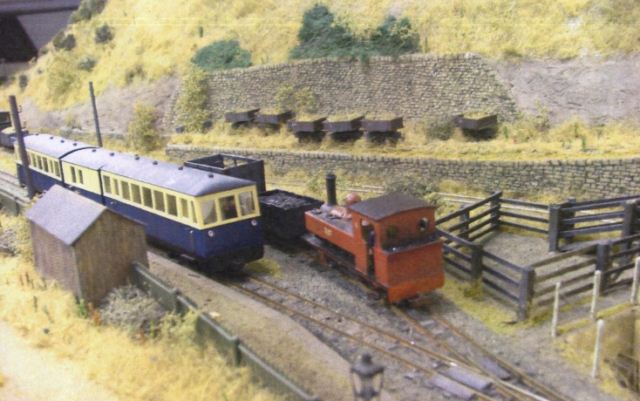
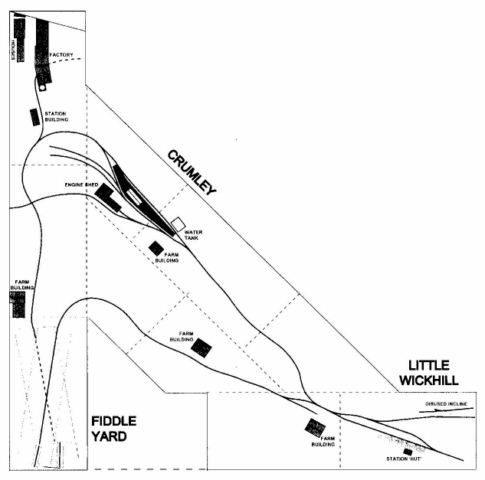
When the RVT eventually reached Crumley, the company realised the intended roadside station site was on a slope! Luckily a convenient side valley on the edge of town provided a level site for the yard, solving the problem.
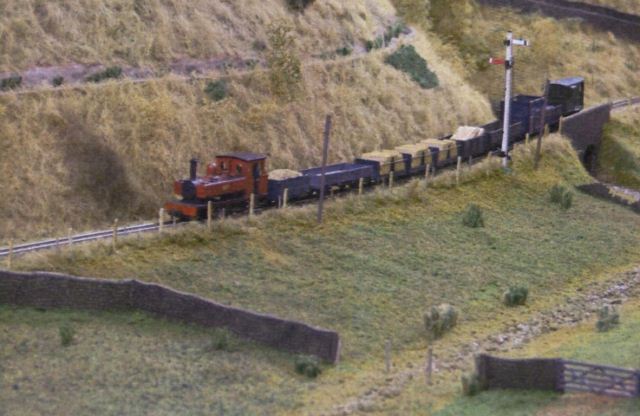
This proved a fortunate choice when the next extension was planned, and the directors realised the next town was 300 feet higher up. An existing mineral tramway up the valley was acquired, the top of the valley levelled to give a reversing point (named Little Wickhill after a local farm) from which the new line was constructed up the far side of the valley and on to the moor top.
The model depicts the section of the RVT in the early 1930's. The best days are gone but traffic remains reasonably heavy. Road services have siphoned off some passengers, but the line is still the shortest route from Moorton to Ramton, so traffic remains steady. To reduce costs, several diesel locos have been tried, but larger trains still need steam locos, which have their own servicing facility at Crumley.
From time to time the line also hosts new locos on trial from various Leeds based manufacturers, the steeply graded line giving a good test for locos intended for colonial railways.
If you have any questions (and can spot the operators) please feel free to ask.
-
 Title
Title
-
Title
Title
-
Title
Title
-
Title
Title
-
Title
Title
-
Title
Title
-
Title
Title
-
Title
Title
-
Title
Title
-
Title
Title
https://www.narrowgaugenorth.org.uk/index.php/85-public-news/exhibitors-previous?start=128#sigProIdf245067c61
A 009 layout by Roger Blackburn
Scale 009 (4mm/1ft)
Gauge 9mm
Size 10’ x 7’
This is a OO9 model of the Leek and Manifold Railway, presuming it was built as a narrow gauge railway from Leek Brook Junction. Waterhouses becomes a passing station instead of an interchange and the railway is extended to Longnor, further along the Manifold valley from Hulme End.
It is also presumed that the railway did not close in 1934, but continued as goods only until taken over by BR and eventually preserved.

https://www.narrowgaugenorth.org.uk/index.php/85-public-news/exhibitors-previous?start=128#sigProIddcc3c38e2a
|
A 1:48 Scale layout by Peter Kazer |
 |
The 3' gauge Ravenglass and Eskdale Railway (known as Owd Ratty) was built in 1875 in the remote coastal area of Cumberland. It was built to transport iron ore from the workings in the Eskdale valley to the coast, for onward shipment to the iron works in Workington. It was not built to the highest of standards and the quality of its construction received a scathing report from the Board of Trade Inspector, following his formal inspection the following year. Remedial works were carried out and the line reinspected in November 1876, when it was finally allowed to open to passenger traffic. However the line did not prosper, and in 1877 it was placed in chancery.
Boot was the upper terminus for the railway and here it served the Nab Gill mine, as well as the village of Boot. After closure of the mine intensive advertising did manage to raise some tourist traffic, particularly on Bank holidays, and at times all available stock, including wagons, was pressed into service to provide accommodation. The railway managed to struggle on but finally closed in 1913 only to be reincarnated as La'al Ratty in 1915.
The railway had two locomotives, Devon and Nabb Gill, built by Manning Wardle in 1875 and 1896 respectively. They were not fitted with air brakes until 1895 when they lost some of their early Victorian features, and by 1908 Nabb Gill was out of service. Passengers were catered for by two coaches built by the Bristol Wagon Company supplemented by the "Big Saloon" which was built locally, and resembled a "cattle truck". The guards van, with its birdcage, was also built by the Bristol Wagon Company.
The railway originally purchased a limited number, possibly four in total, of two types of wagon from the Bristol Wagon Company for general use (including passengers when demand was high!), and built ore wagons locally.
There are very few photographs of the railway around 1880, and fewer still of Boot, and as a consequence, some assumptions have had to be made in order to complete the model you see here.
A 5.5mm layout by Mike Chinery
Scale 5.5mm/1 foot
Gauges 12mm & 16.5mm
Size 6’ x 1’6"
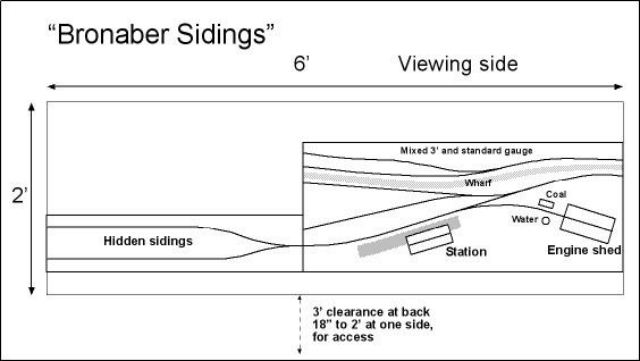
This small layout has been produced in order to show what is possible in this scale. The rolling stock, track, figures and road vehicles are all commercially available. The scale itself is unusual, but has been around for a long time. It was introduced by GEM in the early 1960's, and was used to produce the first commercial range of British narrow gauge models. It had great potential but lost out to the introduction of mass produced HOe scale (3.5mm/foot on 9mm gauge track) models from the continent.
In the late 1980's an Association was formed to support the scale and in 1996 Malcolm Savage bought the original range from GEM.
Many of the old models have been improved and reintroduced, and new models have been produced. Other manufactorers have started making their products available in this scale, something that never happened the first time around.
Please see here for futher details of the 5.5mm Association

https://www.narrowgaugenorth.org.uk/index.php/85-public-news/exhibitors-previous?start=128#sigProId12cb405383